The Calaboose African American History Museum is small enough to overlook and important enough that overlooking it would distort San Marcos. The building began as a county jail in 1873. After Hays County constructed a replacement, the City of San Marcos acquired the earlier structure in 1885. In the twentieth century it became a Black community space and, during World War II, a United Service Organization center for African American servicemen excluded from the white USO by segregation.
That transformation—from confinement to community use to museum—is not a neat redemption story. It is evidence of how Black San Marcos made space inside institutions and buildings shaped by unequal power.
The Dunbar neighborhood is the larger exhibit
The museum stands within the Dunbar Historic District, a historically Black neighborhood southwest of the courthouse square whose development reaches back to Reconstruction. The district contains residential, religious, educational, commercial and cultural resources. It was listed in the National Register of Historic Places in November 2024, affirming what residents had long known: this is a coherent community landscape, not a handful of disconnected markers.
Dunbar Park occupies the site associated with Black education. Organized public schooling for Black children in San Marcos began in 1877 with fifty pupils. The school later carried the name of poet Paul Laurence Dunbar. Integration changed the campus, and a 1987 fire destroyed the original school portion; the Home Economics Building survives. The city’s Dunbar History Walk makes the park a public starting point, but a visitor should remember that neighborhood streets remain residential.
What the museum preserves
The museum’s exhibits connect Black military service, the San Marcos airfield and segregated USO, the Colored School, local businesses and family life. Its work is unusually valuable because national history often reaches visitors through local objects: uniforms, photographs, school records, oral history and the remembered layout of rooms.
The Calaboose also preserves music history. Eddie Durham, born in San Marcos in 1906, became an important jazz guitarist, trombonist, composer and arranger associated with the swing era. The Eddie Durham Jazz Festival carries that legacy into present public life. This is the right kind of continuity: not a frozen “heritage” display, but a community using history to produce new gatherings.
Ulysses Cephas and Black enterprise
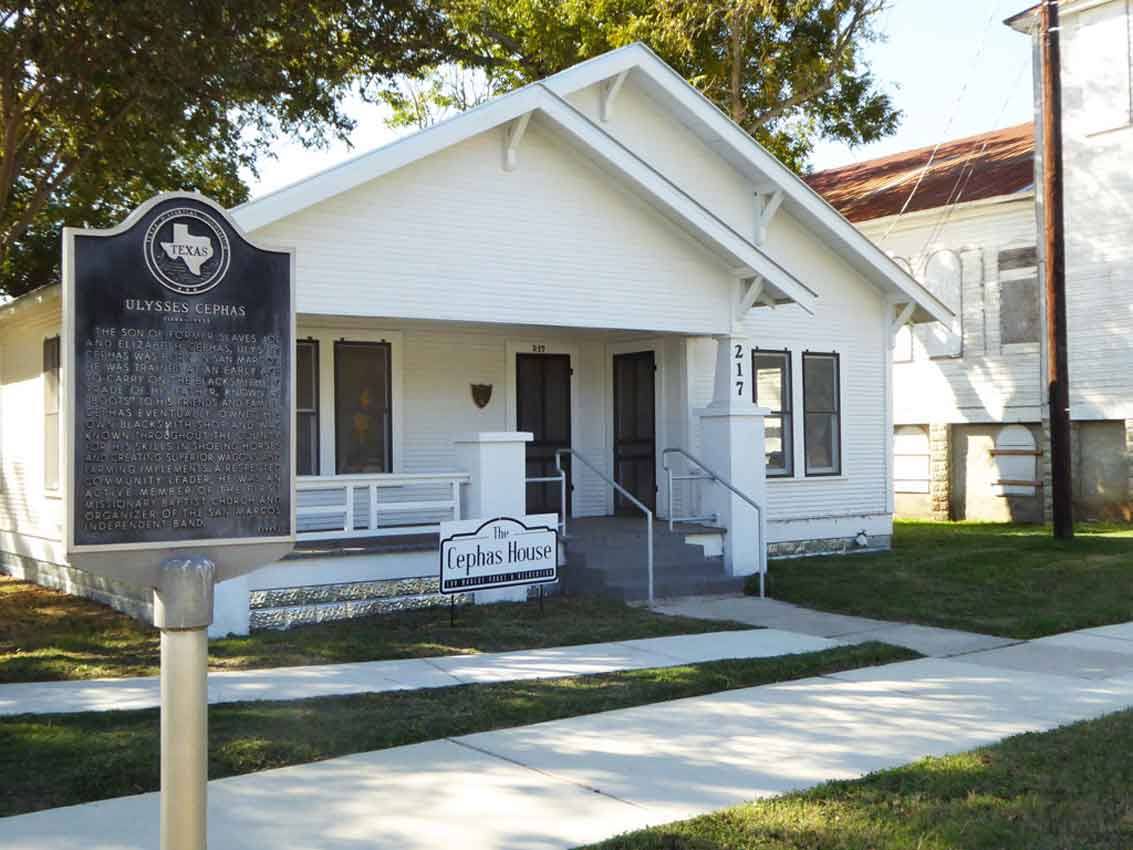
Nearby Cephas House expands the story from institution to individual skill. Ulysses Cephas, born to formerly enslaved parents, worked as a blacksmith, carpenter and community leader. His surviving home helps make Black enterprise and technical knowledge visible in a city where African American history can otherwise be reduced to segregation alone.
The Calaboose’s planned expansion into the Mitchell Center should strengthen interpretation and capacity while preserving the older museum building’s cultural meaning. Verify the active exhibit location and any special programs before visiting, since institutional transitions can change what is accessible.
A respectful two-hour route
- Calaboose Museum: allow forty-five to seventy-five minutes and speak with staff or volunteers when possible.
- Dunbar Park: read the school landscape and history-walk interpretation.
- Cephas House: view from the public approach unless a program explicitly opens the building.
- Eddie Durham Park: connect the neighborhood to the music history celebrated today.
Practical visit
The museum currently lists Wednesday through Saturday hours of 10 a.m. to 2 p.m., or visits by appointment. Admission is free, with donations encouraged. Hours and exhibit access can change; confirm directly before making the drive. The compact building rewards conversation and careful reading more than speed.
Why this belongs in a Gruene guide
San Marcos is not filler “beyond” New Braunfels. The city extends the same regional questions about springs, settlement, education, segregation, military service, music and growth. Pairing the Calaboose with Black New Braunfels makes both stories clearer: small Black communities created durable institutions even when dominant public narratives made them difficult to see.